This is the 3rd and final part of a series of blog posts on the origin and nature of spreadsheets.
Make sure you check out the first two parts:
Now for the third thing you don’t understand about spreadsheets:
Spreadsheets run the world
Have you used a spreadsheet today? They are so ubiquitous that you might not even remember:
- Do you have an Excel window open in the background?
- Do you have a browser tab open with a Google Sheet?
- Did any of the emails you received today have one as an attachment?
Odds are at least one of these things are true, because spreadsheets are everywhere. Here are a few numbers for you:
- 1.2 billion people use Microsoft Office (WindowsCentral, March 2016), odds are most of them have at least access to Microsoft Excel.
- Microsoft believes that 1 in 5 adults in the world use Excel (“What’s new in Microsoft Excel”, Sept 2017)
- Excel is the number one skill mentioned in job ads, mentioned in approximately 1 in 3 job ads! (Indeed.com Job Trends, June 2017).
- In 2010, RescueTime found that about 25% of computer users used Excel on a daily basis and that about 2% of all time spent on a computer anywhere was spent using Microsoft Excel, second only to email software — and presumably web browsers. (RescueTime.com — I’d love to find newer, similar numbers — let me know if you know of something).
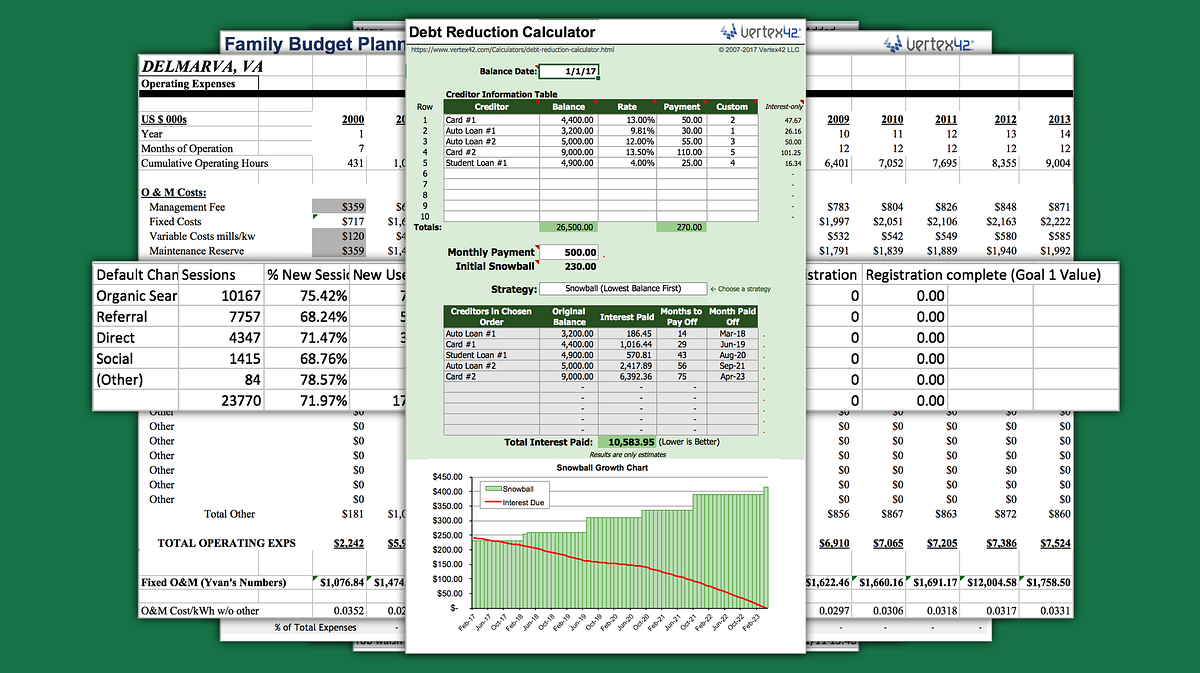 Spreadsheets for all occasions (top example from the Excel template library Vertex42)
And spreadsheets are used for everything. From light-weight databases, to todo-lists and scheduling, data gathering, data analysis, and sophisticated business processing. These are all examples of common uses for spreadsheet software, and this is obviously by no means a comprehensive list of the things spreadsheets are used for. This, despite the fact that there are specialized tools for almost all of these tasks that are objectively better suited for them.
In fact, spreadsheets have serious shortcomings:
- They are error prone and difficult to test.
- Their underlying logic is opaque and hard to understand for others than the author (and even for the author when she comes back to a spreadsheet a few months later).
- They are largely a single-user, desktop tools and not “native” citizens of the web. Online spreadsheets are still fairly basic compared to Microsoft Excel’s power running on a local machine, but what is worse: With the exception of (some) collaboration features, they are largely a transfer of the desktop-client metaphor to a client running in the browser with little notice of the things that are truly different when you’re running “in the cloud”.
These problems (and many more) coupled with the fact that they tend to grow like weeds and multiply without any governance or oversight in every organization is what many managers and IT people refer to as “Excel-hell”. Little do they know that the every-day operations of their business are probably critically reliant on various spreadsheets running on employees’ local machines across every function and area of their companies.
So why are spreadsheets so prevalent?
There are many reasons for the prevalence of spreadsheet software. Among them are:
- Everyone has them: As cited above, Microsoft Excel is installed on virtually every computer in the world, ready to be fired up for any of the above (and many other) tasks at no extra cost or trouble of the user. For the few that don’t (or tasks that require more collaborative authoring) Google Sheets are free and available online at all times.
- Interoperability: Because everyone has them, you can send anyone a spreadsheet (read: Excel-file) and trust that they will be able to open it.
- Learning curve: Even when people realize there may be a better tool for their task, there’s never the right time to learn that new tool: “I can do it in a day in Excel, I’m not going to study Python / Access / R / Qlik Sense / Tableau / Visio for a week just to get started!”And this remains the conclusion even if the user has to spend a full day on the same task month after month.
The Magic Blackboard
Above anything else, it is the flexibility of spreadsheets that ensure their popularity. Dan Bricklin’s original vision at the lecture in Harvard Business School in 1978 still captures the unique power of spreadsheets:
“I imagined a magic blackboard, that if you erased one number and wrote a new thing in, all the other numbers would automatically change […] I imagined that my calculator had mouse hardware on the bottom of it and a head-up display like in a fighter plane.”- Dan Bricklin, TEDxBeaconStreet 2016
The freedom to conjure a “magic blackboard” and simply type without any restrictions or rules or prerequisites — sometimes growing your creation over time into an elaborate business application — is still the spreadsheet’s biggest strength. And what causes IT-people, “serious” programmers and financial auditors the biggest heartache!