With the rise of next-generation productivity tools I feel that we are about to witness a two-pronged race:
- A race to become the best generic “surface provider” for different surface types.
- A race to become the best “block provider” for each of many specific purposes, delivered into a surface of the users’ choice.
In this context, a “surface” is a collaboration tool where content is consumed and collaborated on:
- Document surfaces: Such as Notion pages
- Presentation surfaces: Such as Pitch decks
- Whiteboard surfaces: Such as Miro boards
And a “block” is a specific type of content, such as:
- Text blocks
- Video blocks
- Illustration blocks
- Chart blocks
- Embed blocks providing views into content from other systems
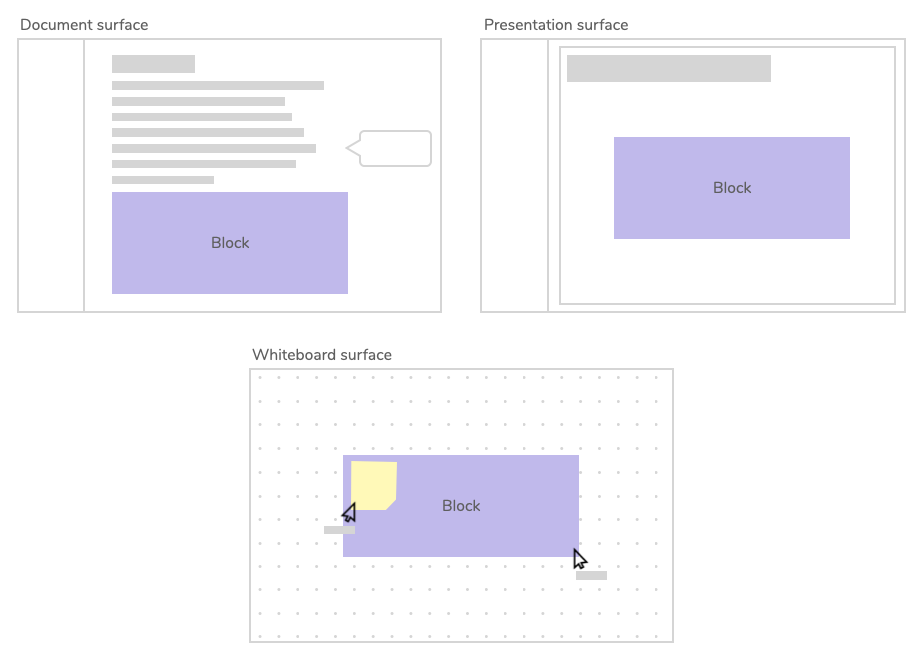 Blocks and surfaces
Until recently, the lines have been quite blurred as many of the block providers have been building their own surfaces, and the surface providers have been broadening their selection by building more and more specific block types.
The examples of the former are numerous (links are to additional information about the respective product features):
- Products that are at heart not “document editors”, ranging from ClickUp and Asana to pretty much any data science platform to as wide a variety of solutions as Amplitude, Typeform, Datadog and Airtable — to name only a few — releasing document surfaces called “documents”, “stories”, “interfaces”, “reports”, “notebooks”, etc.
- Many BI and Analytics products as well as Canva, Figma, and others offering presentation-like “full-screen mode” or “decks”.
- Purpose-built tools releasing their own collaborative “virtual whiteboards”, such as ClickUp and analytics provider Count, recently introducing their (fantastic) Count Canvas.
But good surfaces are hard to build. If you’ve used any of the document editors mentioned above, you’ve probably quickly experienced something that felt a bit off: drag and drop functionality is limited, selections are weird, formatting text either carries to a new line when you don’t expect it or is impossible to apply where you want it. Copy-paste is flaky. And how do I escape from that endless bullet list!? The quirk list goes on…
It turns out that great editors are really hard to make. Even the poster-child in the new “document surface” category — Notion — receives comments like these:
[Image no longer available]
The same goes for presentation and whiteboard surfaces. They are really hard to make, and if building them isn’t a company’s primary job you don’t stand a chance of making them as well as those whose primary business that is.
Similarly, those that build the best surfaces will not be able to provide all the purpose-built blocks their users will need. Building the best surface of a particular type and providing all the basic blocks is hard enough, and good blocks beyond the very basics require specialization.
Therefore I think we’ll start to see a division where only a handful of companies will be competing to be the leading “surface provider” in each category:
- Document surfaces: Notion, Coda, and Craft
- Presentation surfaces: Pitch, Visme and Beautiful.ai
- Whiteboard surfaces: Miro, Mural, Canva and Lucidspark
Meanwhile, surface providers can’t be expected to build the best purpose-built blocks for every occasion. Therefore, the winning strategy for them will be to open up more to embedding and injection of content from purpose-built tools. Notion’s release of link previews (to which GRID was a launch partner) is a good example of this and shows how going beyond simple embedding can make this much more impactful.
It’s also clear that modern teams will not accept using one document editor, collaboration pattern, storage and search for their Amplitude insights, another one for their Typeform surveys and a third for the structured data they store in Airtable. Quite the contrary, they will often want to bring insights from all three together in a single document, to edit, store, discover, and collaborate on in their favorite document surface, present in their favorite presentation software or brainstorm about using their favorite virtual whiteboard.
Back in the day, we had Word and PowerPoint as the main consumption surfaces. But the content that went into these documents and decks was made using tools ranging from the broad purpose Excel and Photoshop, to very specific ones. The “embedding” of content was usually in the form of a screenshot copied from the metaphorical “block provider” and pasted into the surface of choice.
Similarly, we will see numbers tools (such as GRID), illustration software (such as Sketch or Figma) and purpose-built tools like GitHub and Amplitude (to use a couple of examples from Notion’s link preview launch ) that deliver the best functionality and blocks for their respective categories.
Such blocks could, in turn, be reused across multiple surfaces — you might see interactive GRID charts or Sketch prototypes in Notion, Pitch, and Miro alike. The level of reusability obviously depends on how and to what extent each surface provider opens up to such “block ingestions”.
The richer the embedding, the better the overall experience will be.
It is quite likely that oAuth and the further evolution of something like oEmbed will play a role in standardizing these patterns across surface providers.
The role of Google (pageless documents anyone?), Microsoft (hello Loop) and even Atlassian in these races will also be interesting, although I fully expect the new guard to lead the race in the coming years.
Thoughts?