Originally published on the GRID blog.
Leave facts to databases and calculations to algorithms
The more I use, experiment and develop against LLMs, I more firmly come to the conclusion that their primary benefit is allowing computers and humans to finally interact in the languages of humans, rather than the languages of computers.
Needless to say, natural language comes — uh — naturally to humans, but computer languages, ranging from Assembly to Python, JavaScript and Excel formulas do not.
So, the ability of LLMs to understand natural languages and translate them into a computer language fitting for the task at hand is the real revolution. It lowers the barrier to get a computer to do what you want.
You no longer need to first learn a new — and quite unnatural — language or use purpose-built software. You just need to be able to communicate the task in a natural language well enough for the LLM to correctly formalize the request in a computer language. Something that depends both on the quality of the LLM and the communication skills of the human.
To me, this also means that rather than focusing on training LLMs on ever more data to expand their “knowledge” or training them to learn arithmetic and logic from examples, the focus should be on improving the translation from natural to formal languages and give LLMs access to more of our tried and tested software tools.
After all, logic, calculations and looking up facts is what computers have always been good at. Let’s leave those to traditional algorithms and databases. Efforts to train LLMs on the long tail of the entirety of human knowledge and learn math and logic by training them on ever more data is a highly inefficient, and demonstrably futile effort.
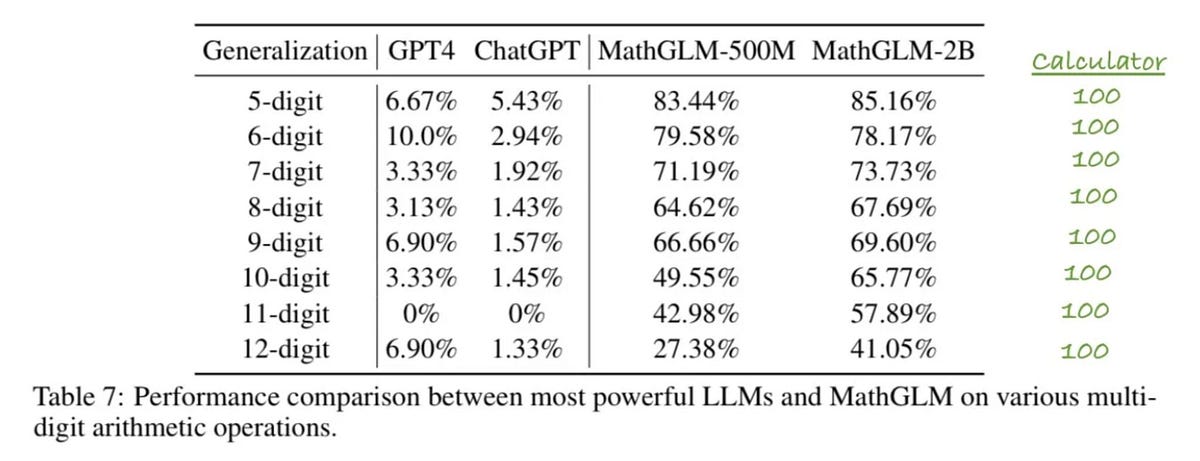 From Gary Marcus’ article “Math is Hard”
We don’t need LLMs that do math 84% right. We need algorithms that do math 100% right.
We don’t need LLMs that come up with plausible — but often wrong — answers to factual questions. We need lookups in reliable databases that answer what they “know” and know when they don’t have the answer.
The breakthroughs of LLMs are in installing language and — in a sense — creativity into computers. Facts and arithmetic already were.
—
Hjalmar Gislason is the founder and CEO of GRID. If you like this post make sure to follow us on Medium and Twitter for more to come.