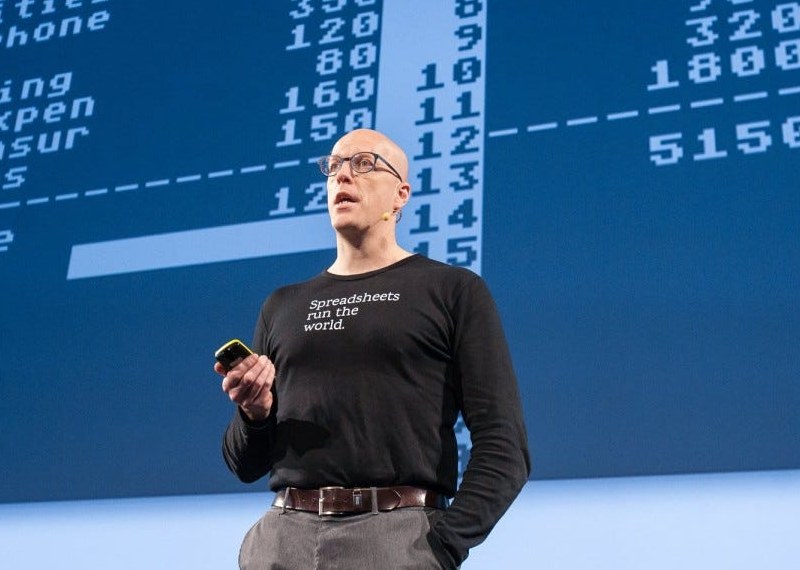
For decades, the spreadsheet has been where the world does its thinking with numbers. It quietly became the most widely used programming language in the world, and hundreds of millions of people who would never call themselves programmers build working models in it every day.
That era is ending, and not only for spreadsheets. Authoring is moving to AI across documents, slide decks, web apps, and yes - spreadsheets. Instead of starting with a blank slate, we describe what we want in plain language and let a machine draft the artifact. The handmade spreadsheet, built up cell by cell by a person, will become a rarity. Before long it will feel as quaint as hand-coding a web page in Notepad.
Where the calculations go
Once a machine is doing the authoring, a spreadsheet is no longer the obvious format for the response. Where the calculation ends up instead depends on the kind of task, and on how much rides on getting it right.
- Consumer tasks (splitting a bill, a home budget, the cost of a trip). People used to open a spreadsheet for this. Now they ask AI and get back a report or a small web app. The spreadsheet never appears at all.
- Operational tasks (team dashboards, sales pipelines, the startup model everyone argues over). These are moving to generated dashboards and web artifacts. A spreadsheet might sit underneath as the data source, but the logic that drives them is increasingly written as code, in Python or JavaScript, rather than in cells.
- High-stakes tasks (financial planning, M&A models, anything audited or regulated). Here the spreadsheet prevails, and will for a long time yet. Excel is the language of finance. The models get checked cell by cell by people who have to answer for them. Nobody trusts that to a black box.
Seen this way, AI is not so much killing the spreadsheet as exposing what it is: a tool built first for the author, not for the audience. Its real gift is to the person building the model, who gets a live feedback loop where every intermediate value sits in front of them as they work. The reader is handed the finished wall of numbers with the reasoning collapsed inside it. It became the default way to deliver a calculation largely because it was what everyone already had and knew how to open, not because it was ever the best vehicle for the reader.
What every calculation needs
But, whatever the format, two things will always matter for any calculation:
-
Quality. A calculation has to be correct, deterministic, verifiable and repeatable, something you can open up and inspect rather than simply believe.
-
Legibility. A human has to be able to understand the model they are being asked to trust. As they say in finance, if you understand the spreadsheet, you understand the deal: the model is the deal, and trusting it means being able to read it.
Today’s AI is uneven on both counts. Ask it for a number in chat and you get neither: a confident answer, not verifiable, with no way to see how it was reached, which leaves you trusting it blindly. The moment it produces something runnable instead, a snippet of code, quality comes within reach, because the computation is deterministic and can be checked. Legibility is where it still fails. AI tends to show its work as Python or JavaScript, which almost no one outside of engineering can actually read.
The spreadsheet’s edge here is easy to misread. Cell for cell, a formula is no more legible than the equivalent line of code; the syntax was never the point. What it has is familiarity: orders of magnitude more people already read spreadsheets than read code, and in finance that gap is close to absolute. This doesn’t make the spreadsheet inherently clearer than code. It just makes it the calculation that the most people can actually check, and that is exactly the property we are now at risk of throwing away.
What comes next
Calculations themselves are not going anywhere. If anything, we are about to produce far more of them than ever before. What is changing is that the spreadsheet is no longer the right format for all of them. In high-stakes finance, where every number has to be checked and someone has to answer for it, it will hold on for years yet. Everywhere else, its grip is already slipping.
Familiarity is something a new format cannot inherit, but the rest of legibility, letting people follow the working and check it for themselves, is something you can design in from the start. That gap, between an explosion of machine-made calculations and our basic need to trust the numbers, is one of the largest and least-noticed openings AI is creating.
Whoever works out how to make calculations that are correct, legible, and trustworthy, in whatever shape the audience needs, will build the next thing that quietly runs the world.