Originally published on the GRID blog.
GRID has already given spreadsheets a new face. In 2022 we’re transforming GRID to become the primary tool of choice for modern teams working with numbers.
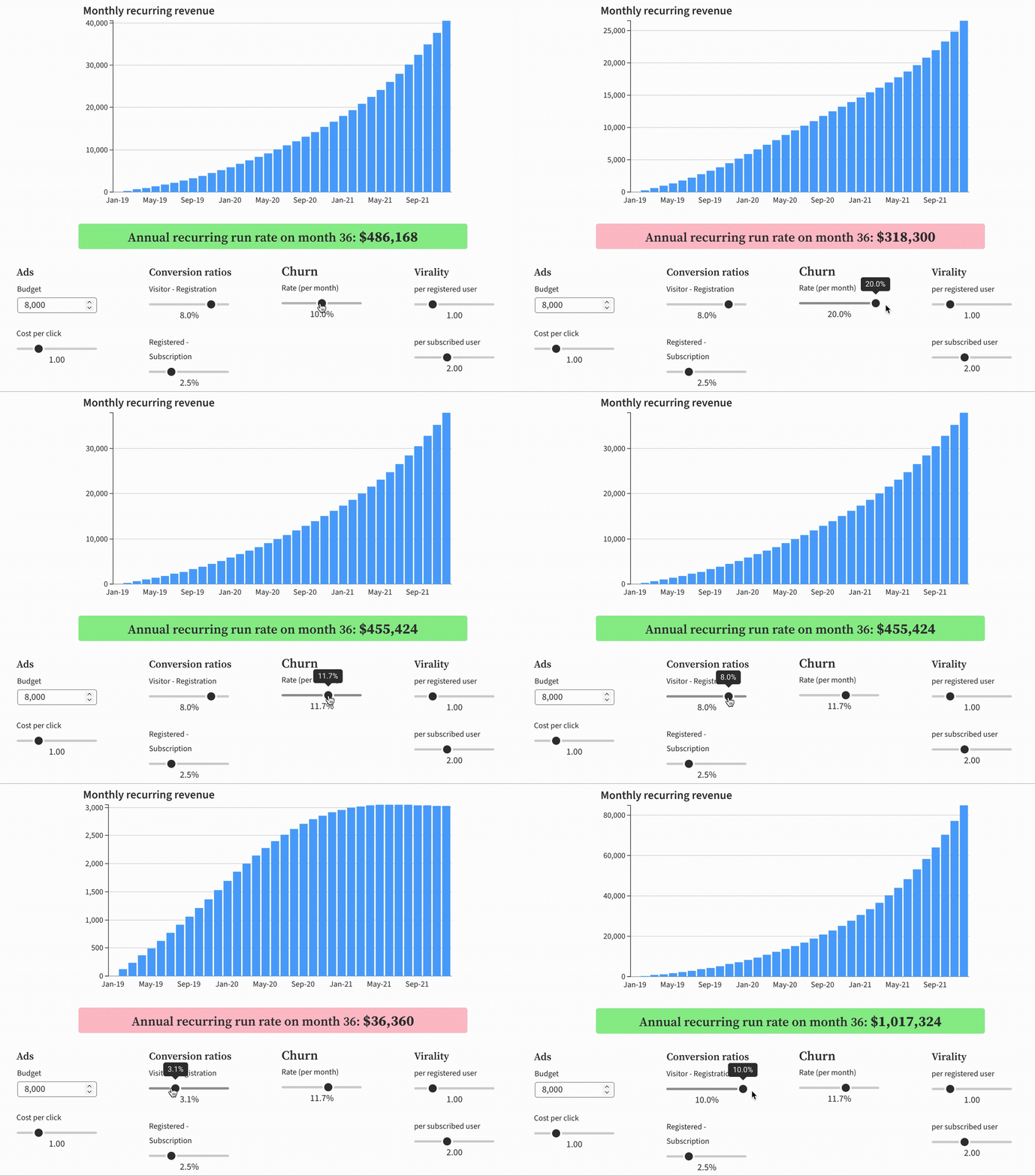 A spreadsheet model, come alive through GRID
GRID was founded around the core insight that working easily with numbers should not only be for the initiated, but is something that hundreds of millions of people need to do every day.
The software industry has been busy building tools that enable experts — such as BI experts and data scientists — to do more and more complex things. Meanwhile few have paid attention to making everyday data tasks easier and more delightful for the rest of us.
 There are orders of magnitude between the number of people that work with numbers and calculations every day, and those that know how to use specialized data and analytics tools to do so.
This was brought home in a recent user interview with a young and smart knowledge worker who occasionally teamed up with a data scientist:
“[The Data Scientist] can do amazing things with millions of rows of data. I just need something that allows me to do what I want with a thousand rows”.
This is the type of work that today gravitates towards spreadsheets.
Spreadsheets are a bit like oxygen. People use them all the time without giving them much thought. And as such, they are the common denominator for all data work, especially anything that has to do numbers and calculations.
It was therefore obvious that any journey improving on the ways people work with numbers would begin with spreadsheets, building on knowledge that people already have and assets that businesses have already created. The switching cost of learning how to use a new tool from scratch, let alone rebuilding assets that have emerged over years or even decades is simply too high to ask — and frankly the reason many of the self-service data tools out there haven’t taken off as anticipated. A busy knowledge worker doesn’t have the time to learn how to use a new tool, while building on their knowledge of spreadsheets to solve a new problem is a much lower hanging fruit. The gradual learning curve of spreadsheets is a powerful thing.
So, GRID is built on the core principles of traditional spreadsheets while enabling users to go beyond what is possible with the spreadsheet software of today. “Embrace and extend” to borrow a familiar phrase.
This means that we’ve invested heavily in a few fundamental building blocks, the most important ones being:
- A spreadsheet engine: We wrote our own — Excel- and by extension Google Sheets-compatible — spreadsheet engine from scratch. It’s now arguably one of the 5 most powerful spreadsheet engines in the world, and by far the most powerful that can run entirely in your browser. This is a benefit that will pay off in a myriad of ways, the most obvious one at the moment being the engaging interactivity GRID documents offer on top of spreadsheet models.
- Direct connection with cloud workbooks to immediately reflect any updates to our users’ Excel and Google Sheets spreadsheets in GRID documents built on top of them, whether while editing or at viewing time.
We then decided that the first place we’d deliver value would be to give spreadsheets a modern presentation layer — a “new face” — as we put it. The rigid row and column structure of spreadsheets is great for setting up the data and the calculations, but has its limitations when it comes to things such as adding text and other media, layouting, and the responsive behavior we naturally expect nowadays for mobile usage. The web offers a much richer way to present and interact with data and numbers, and spreadsheet users shouldn’t be missing out on that. Here’s a simple example:
 This is not an image, but a GRID document embedded in Medium. Try moving the sliders.
Enabling this required the third core building block:
- A WYSIWYG editor that enables anyone to build these engaging documents, provide context to the numbers and models and seamlessly share them with others, whether directly on GRID, embedded in other web tools — ranging from WordPress and Wix to Notion (see how) and ClickUp — or even as interactive charts in your presentations.
With these building blocks in place we were ready to launch our first commercial offering: GRID — the publishing tool; a “single player” tool that allows spreadsheet users to bring in the spreadsheet data and models they’ve already built using Excel or Google Sheets, choosing the parts of the model they want to expose and how, provide text and other media for context and then publish to a limited audience or the world as a whole while remaining in full control of their underlying spreadsheets and their distribution.
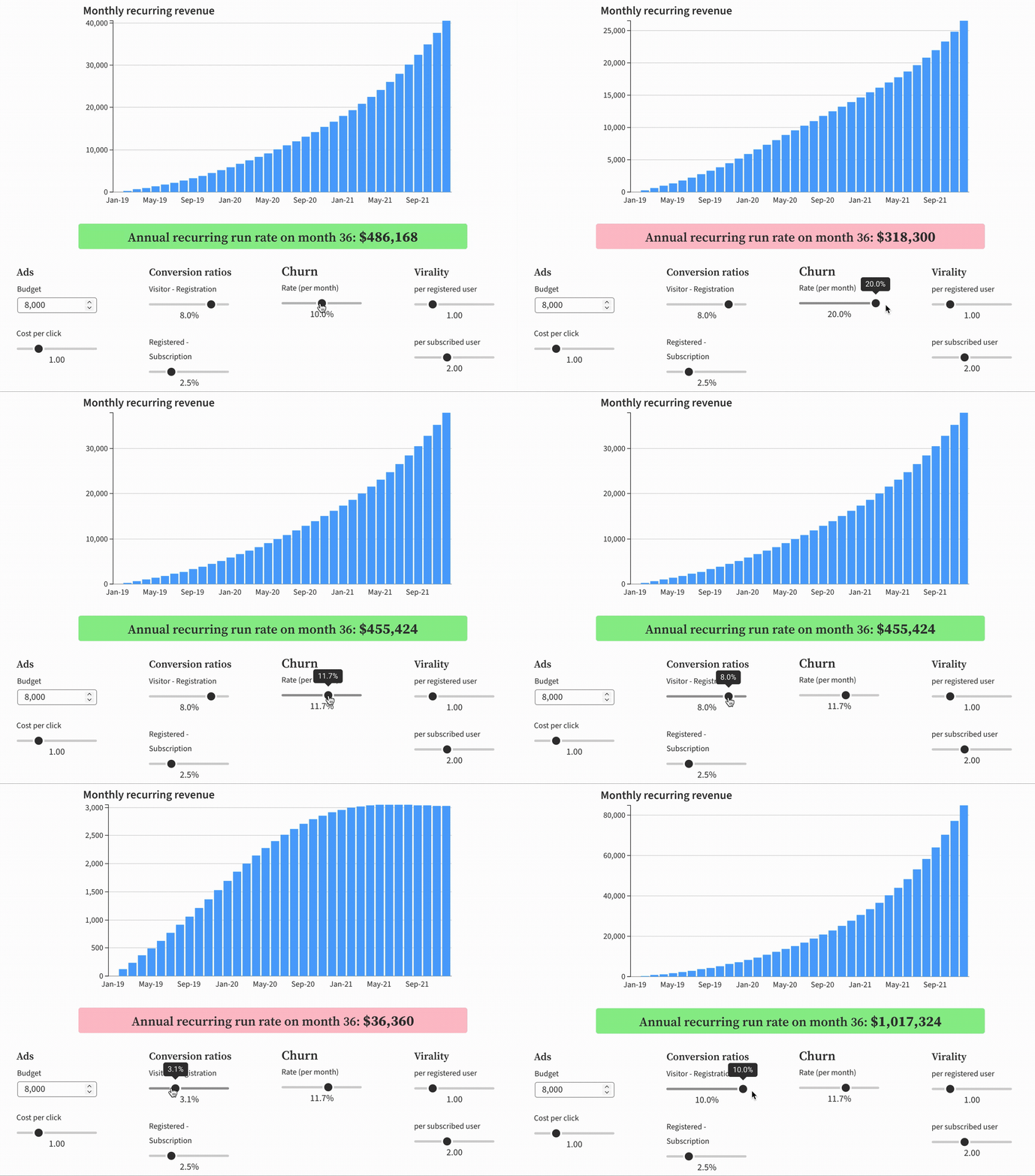
Since then, hundreds of customers and thousands of users have used GRID to create a broad range of documents ranging from long form interactive explanations (1, 2, 3) to various embedded calculators (1, 2, 3) to plain fun (ok, those last two are mine!).
While this has been somewhat successful already, we realize that only a fraction of the work that gravitates towards spreadsheets in today’s businesses ends up as external facing assets for wide distribution. So, while 88% of spreadsheet users say they share findings from their spreadsheets with others (source), most of that is for internal purposes.
The anatomy of a typical spreadsheet’s lifecycle goes something like this.
- Exploration: Almost every spreadsheet begins its life as the work of a single person — a modeler. They’ve either had a hunch they decide to explore, or they’ve been asked a question that can be best answered by bringing together data from a few sources to do some ad-hoc analysis. If this effort is fruitful, it moves onto the next stage.
- Explanation: The modeler now needs to share their insight with someone else. Occasionally this means sharing the spreadsheet itself, but the modeler often feels uncomfortable doing so for a variety of reasons. So this — as well as the fact that the insights from the model usually require more context for explanation — usually means copy-pasting charts or tables from the spreadsheet into slides, emails or long-form documents.
- Conversation: Whether the explanation is presented live or shared asynchronously, a conversation will typically ensue. Some may happen in meetings, but IMs on Slack or Teams, or emails are probably more common. The conversation will frequently include questions that require the modelers to “run the numbers again and get back to you” or even entirely new questions that require the model to be expanded or a new one started from scratch.
- Operation: Finally, if the insight is important enough or the model turns out to be a valuable tool, the modeler will be asked to repeat the process, often on a regular basis: monthly, weekly, daily. Even to make sure it is up-to-date at all times. Using traditional spreadsheet software, some of this can possibly be automated to some extent, but that will require significant additional work and often technical skills and access beyond the level of the original modeler. More often the choice is to move it to a different tool (and often a different team, such as IT or “the BI people”) or doing significant manual work every time the model or report needs to be run again. You won’t believe how many people spend a sizable part of their time — some even the majority of their work (!) — running, re-running and servicing such models. And some of these models have a history running back more than a decade.
This lifecycle is messy and hopelessly disconnected, moving from spreadsheets to presentation software to emails and IMs and back again with daunting manual work at every step of the way and the associated risk of mistakes and outdated insights.
GRID, the modern collaboration tool for working with numbers
If any of the above sounds familiar to you, you should pay careful attention to what GRID is rolling out this year.
Imagine if this whole process, from exploration to explanation to conversation to operation, was covered in a single, collaborative tool that kept everything tied nicely together. Here are just a few examples of the benefits:
- When explaining, the modeler could easily pick and choose the parts of the data and model they want to expose while keeping other parts hidden.
- There is no need to “rerun the numbers” because the model is already tied to the explanation and the audience can interact with it without risk of ruining anything for the modeler or other viewers.
- Any conversations — even if they are happening in e.g. Slack — are tied to the explanation so that questions and insights by the audience are captured in context, adding value and understanding to the model with every comment made.
- When changes are made to underlying data, they are reflected wherever this data is presented whether directly or as input variables to a model that in turn may feed charts and tables in an explanation or a presentation, freeing the modeler up from manual maintenance and minimizing the risk of errors and outdated insights.
And all of this in a user-friendly, modern collaboration tool that’s nicely integrated into the everyday tool stack of the modern team: Slack, Google Workspace, Notion, ClickUp, etc. Even Excel and PowerPoint 👴
This is what GRID is building, and we’ve already started rolling some of this new functionality out. The explanation layer we’ve had for a while in our GRID documents. We recently rolled out conversations and we will be rolling out a range of further collaboration features in the coming weeks and months. This spring we’ll even have our own native spreadsheet editor enabling the exploration to happen within GRID, even though we still expect a lot of our users to bring in their spreadsheets from Google Sheets and Excel. And we’ll close the loop with the operational layer as we add connectivity to data sources other than traditional spreadsheets later this year.
With this, modern teams will be able to address the entire lifecycle of working with numbers and calculations — from a single user’s ad-hoc exploration to an interactive report available to the entire company — using GRID.
I guess you could think of it as a collaborative notebook for the non-data scientist.
…or what would happen if Notion and Excel had a beautiful baby!
—
Hjalmar Gislason is the founder and CEO of GRID. You can share your comments with him below or on Twitter @hjalli