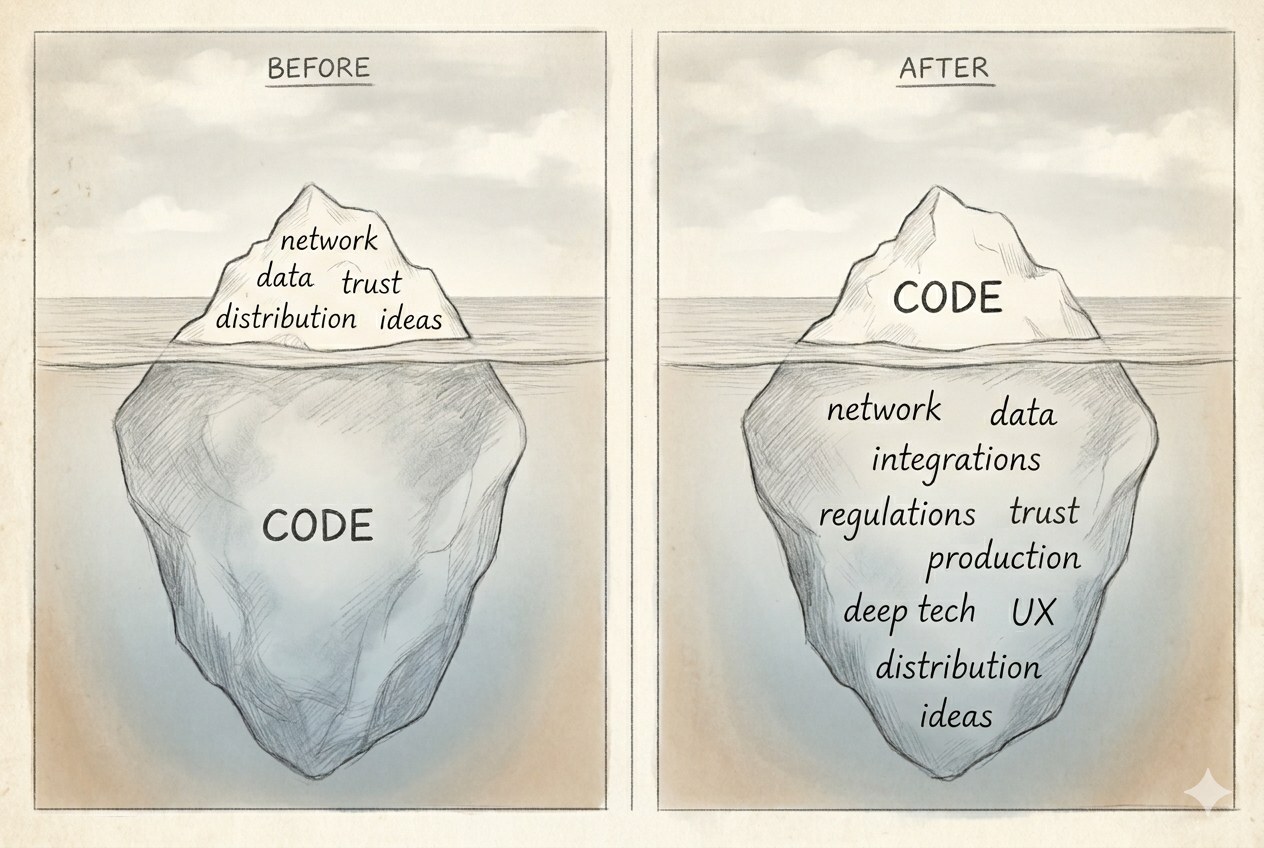
The cost of writing code is falling fast. We can debate how close to zero it gets, but the shift is already enormous.
But coding was always just one part of building software. When it dominated the cost of getting something to market, everything else was easier to overlook. As coding gets cheaper, the rest comes into focus.
A week or so ago I wrote about building for an audience of one - how a solo developer with AI coding tools can now ship in an afternoon what used to take a small team months. That shift is real, and it invites the obvious follow-up.
When code is cheap, what still matters?
-
Network effects. In social networks, marketplaces and developer platforms, the code isn’t the asset. The people, listings, buyers and builders on top of it are. A clone is a weekend project; the networks aren’t.
-
Proprietary data. Unique data, proprietary feedback loops, signals others can’t access. Durably defensible; nothing gets cheaper by prompting harder.
-
Integrations, regulation, and real-world plumbing. API keys, partner programs, app-store listings, bank accounts, wires, hooking into legacy systems, licenses and compliance (HIPAA, SOC 2, GDPR, state-by-state approvals). Most of it isn’t coding. Most of it is slow. It’s political, it takes meetings and endless back and forth. Some of it takes years.
-
Trust and brand. For anything touching money, health, identity or safety, people pick the name they’ve heard of with a track record. Trust compounds over years; it can’t be prompted into existence.
-
Production readiness. Scaling, security, monitoring, maintenance, internationalization and broad, methodical user testing rather than incidental feedback. The gap between “works for me” and “works worldwide, 24/7, securely, in eleven languages” is as wide as it ever was.
-
Deep tech and domain expertise. In medicine, law, logistics, semiconductors, and other demanding domains, AI still needs expert guidance. The bottleneck is not typing code. It is knowing what should be built, what constraints matter, and how to recognize whether the result is actually correct.
-
Product management and user experience. When anyone can ship more features, judgment matters more. What you leave out becomes as important as what you add. The best products are not the ones that do the most, but the ones that feel obvious to use.
-
Go-to-market. This has always been the hardest thing about bringing new software into the world: How will customers learn about your software, quickly understand it, feel the need and decide to buy? What’s the right motion, the right customer, the right price point, the right brand to support it? AI can help with all of this, but it equally helps everyone else, so you’re just competing for attention against even more noise.
-
Problem selection. If execution gets cheaper, choosing the right problem matters more. The scarce thing is not the ability to build; it is the judgment to know what is worth building.
Categories whose main moat was the sheer cost of building are suddenly exposed. This opens a genuine first-mover window for anyone willing to rebuild and disrupt.
What excites me most is not that things that used to take a year now take a week. It is that things that seemed impossible may now be merely hard.
The real opportunity is not cheaper software, it’s tackling the problems we previously could not afford to take on.