 Ok, prove it!
…what they really mean is
“We’ve reluctantly given you limited access to a small portion of your data”
Before I go any further, let me say that I’m a Fitbit fanboy. I have had several trackers over the course of the last few years and I use my Charge 2 and Aria scale every day. I even gave up on the Apple Watch pretty quickly because I preferred Fitbit’s much longer battery live, sleep tracking capabilities and realized I was looking for an activity monitor more than a fully featured smart watch.
But, I’m also a data nerd, and as such I dislike Fitbit’s walled garden strategy. I understand their motivations, but I also think that — even with their own interests in mind — they are misguided. I strongly believe that the winning strategy in their space will be to open their data API’s further.
Let me explain:
Initially, Fitbit only allowed data export to their Premium subscribers. This restriction was lifted in 2015:

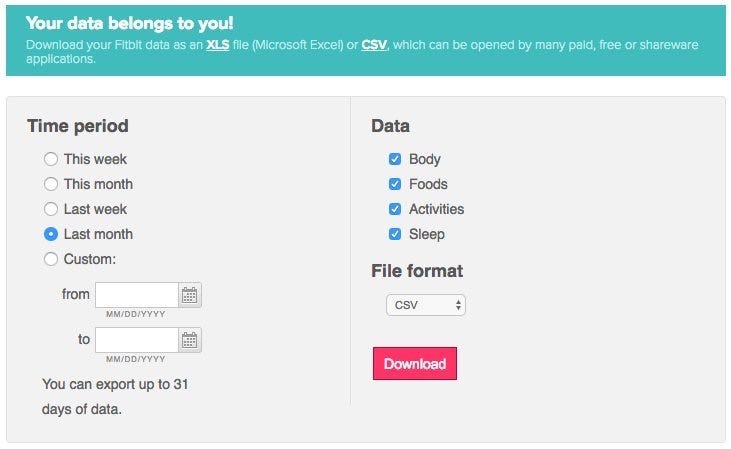
Since then, they’ve allowed users to download activity data from their site for free.
What they offer — however — is very limited, to say the least. Daily aggregates for body, food, activity and sleep measurements. No intraday data, no data for tracked activities, no heart-rate data. And no paid option to get more granular access.
When I moaned about this on Twitter, their response was:
[Image no longer available]
To which I call bullshit! Their own apps seem perfectly capable of loading this data quickly and reliably for hundreds of thousands — if not millions — of daily users. If this was really about server load there are multiple ways to deal with that, including rate limiting the APIs, only allowing large bulk downloads once a day per user, etc.
The reality is that they don’t want the data “out there”. They want to wall their users in to an experience where they can only view and analyze their data through their own tools.
Of course, clever nerds have found their way around this in multiple ways, e.g.:
- simonbromberg/googlefitbit - Google Sheets scripts for Fitbit data download
- corynissen/fitbitScraper - R package to scrape Fitbit data
…and therein lies Fitbit’s problem. Nerds are the early adopters. They would likely leave for a manufacturer that provides better access to data, and the rest of the user base would soon follow suit as new and innovative tools and a more vibrant ecosystem would arise around such an open strategy.
Fitbit’s strategic advantage doesn’t lie in the manufacturing of the hardware trackers — these are pretty much commoditized by now. In fact, they’ve been acquiring troubled competitors to maintain their position in this low-margin, low-barrier-to-entry market.
Fitbit’s strategic advantage lies in their dominant brand awareness and market share. The way to maintain that position is to become a “data hub” for activity data. But this is only possible if users really feel that the data is really theirs, and by providing phenomenal experience and value add around the data hosting.
Like most traditional vendors in the software space I’m sure Fitbit would love to get out of the “perpetual” business (in their case selling hardware) and move to the much more resilient and lucrative subscription business. The key to success there is the data, not the hardware. But like many consumer SaaS companies have found before them, they have to realize that the key to trust is users’ full and frictionless access to their own data. The feeling that the data really “belongs to you”. Not that most people will ever access or download the data, but they want to know that they could — if it came to that. And in a well functioning ecosystem they will want to share the data with other services and in turn have those services share their data with — and store it in — Fitbit’s data store.
Fitbit’s needs to transform itself from being a hardware company selling “perpetual” hardware to being a data company selling consumers subscriptions to an “activity data hub” (which may in turn store data from other “quantified self” trackers) and aggregate data (something they already reserve the right to do) to health providers, equipment manufacturers and research companies.
If they are able to make that kind of transition, Fitbit’s future is bright. Otherwise keeping the margin in an ever cheaper and more competitive hardware market will prove to be really hard.