english

Who will kill Google?

Paul Graham wrote an interesting piece a few days ago about the “death of Microsoft”. Not death in the sense that Nietzsche proclaimed to God, but in the sense Microsoft “killed” IBM. IBM remained (and remains) a strong company through the Microsoft era, but they were no longer ruling the IT industry. The same is true of Microsoft now, but Google holds the throne.

This begs the question: Who will kill Google?

As that question is probably impossible to answer, an easier version is: What will kill Google?

We can say that each of the three previous kings represents an era in IT:

  • IBM: The mainframe era
  • Microsoft: The desktop era
  • Google: The web era

What is the next era? Will it have to do with the semantic web, i.e. “The data era”? Will it have to do with P2P, i.e. “The distributed computing era”? Or maybe the exact opposite – characterized by massive central data storage and computing, i.e. “The massive data center era”?

What other candidates are out there? And who is likely to grab the throne in each scenario?

Trends that shape the future Internet

I’m working on a document as a part of a study by Eurescom on the Future Internet – the Operator’s vision. Our part is on the applications of the future internet and as a starting point we’re identifying several trends that are likely to shape this future. We’re looking 10-15 years ahead in the study so it’s perfectly OK to be a little on the wild side.

All and any feedback on the list below is much welcomed:

  • Mobile and nomadic: Laptops and mobile handsets will be connected to the Internet when- and wherever. Bandwidth to mobile devices will continue to increase and as capabilities of mobile handsets improve, mobile usage of online services and applications will become mainstream. Better batteries (see below) will further limit the need for any sort of cabling or otherwise location dependent work. Twisted pair cables will gradually disappear from the office space.
  • Data storage increasingly on the Net: As users get used to working with their documents and data across many different devices, and “always-on” connections become a trusted reality, data and document storage will move largely online. Applications will more and more make use of this fact. Large attachments in email messages will disappear and be replaced with references to online documents. This trend can already be seen as Friday emails point to videos on YouTube instead of including them as attachments. Online storage has many benefits, such as safer backup procedures and simplified collaboration work.
  • Web interfaces for most applications: The rise of alternative operating systems, such as Linux and Mac OS, coupled with increasing usage from mobile devices, leaves the browser, or – more accurately – Web standards as the common ground to write cross platform applications. These standards will increasingly allow rich user interfaces, in line with the rise of AJAX-based web applications in the last 2-3 years. Current office-suite-like applications, such as Google Docs, database apps like DabbleDB and Swivel and photo editing applications like Phixr, provide a glimpse of what is to come. Consequently, the importance of operating systems declines.
  • Net connection as ubiquitous as electricity: “Always on, anywhere, without caring how.” Users’ devices will be connected to the Net anywhere. Moving from one access technology to another will be invisible to the user. No need to think about GSM1800 vs. WiFi vs. UMTS vs. HSDPA vs. EDGE or WiMAX. Devices will support multiple technologies and Software Defined Radio (SDR) will eventually make the same hardware adapt to pretty much any radio transmitted standard we’ll come up with. Wired connections will still connect homes and businesses, but not the actual end-user devices.
  • Revolution in battery lifetime: Whether solved with fuel cells, new chemical battery technologies or some radically new approach, the economic incentive is simply to great for this problem not to be solved. To some extent, the need for power on the devices themselves will not grow as fast as before as more and more of the computation and data handling moves online. Regardless, the battery lifetime of a handheld device will be measured in weeks and the battery lifetime of laptops (or their future equivalents) in days, instead of days and hours respectively.
  • Overall need for computing power continues to rise: Rising electricity prices, ever more need for computing power and environmental issues – such as carbon emissions are already a big concern for data center operations. Regardless if computation moves increasingly to central hubs such as data centers, or will be more distributed by means of peer-to-peer storage and computation, the total electricity demands are rising rapidly. Radically more efficient computers and data center operations are needed to prevent this from becoming a major hurdle to future application possibilities.
  • Ownership of bits, instead of atoms becomes more acceptable: Today’s common perception that in order to “own” something, a physical object is needed, will fade. User’s will have the feeling of “ownership” of movies, music and books as long as they “own” the right to access and use them on any medium at will. The convenience of a fully controlled digital copy of the content will actually make users feel a higher degree of ownership than with today’s – often artifical – limitations of DVDs, CDs and DRM-ed digital content.
  • Usability will dramatically improve: User centric products will kill technology centric ones. As more attention is given to user centric design, user’s will feel more in control and mainstream adoption will finally happen for technologies that may even have been around for decades already. Intuitive, simple user interfaces and innovative new ways to interact with technology (such as multi touch displays, eye-tracking and voice recognition) will make technology feel warmer and more intelligent – and thereby much more widely and easily adopted.
  • Machine to machine communications: The number of devices connected to the Internet will continue to rise. More and more sensors and other small, automated devices will use the Net to share data and access online services that make use of this data and tell the devices what to do. Software will also increasingly interact with other software via the Net, accessing data, synchronizing efforts and fighting for resources.
  • More devices for the “same” tasks: Convergence will happen. We already see our mobile phones acting as our instant camera, our alarm clock, wristwatch, portable music players and what not. The contradictory side-effect is that users will own ever more devices capable of the seemingly same tasks. The phone camera may be good for casual photos, but an SLR is needed for the safari or the family photos. The Walkman phone may be good for playing music while at the gym, but when you’re home you prefer to use the home media center (plus you want to keep the actual phone handy). The Blackberry may be great for email, but it’s less than great as a phone and is far from being a fashion item. Even highly convergant devices like the iPhone won’t change this. As data is more easily shared across devices, people will pick the handset to go with the shoes and the occasion – notice recent developments with Prada and Dolce & Gabbana co-branding recently launched devices.

Visited Countries – Revisited

When I read Bill Bryson’s fantastic book “A Short History of Nearly Everything“, one of the things that stood out, was a reminder that the world is still a really big place.

Even though we feel that we can – with a credit card, and a solid visa – get pretty much anywhere in the world within 72 hours, the world is still HUGE on the ground level. There are large areas where – to our best knowledge – no man has ever set foot; it still takes days or even weeks of trekking to get to much of Earth’s surface; and humans are still to explore even 1% of world’s oceans.

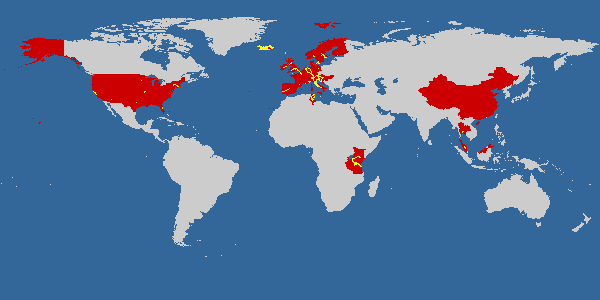
This made me think of Douwe‘s Visited Countries project. You surely know this one – everybody and their grandma’s have been posting these maps on their blogs in the last 3 years, coloring the countries they’ve been to. But that’s not really fair – is it? I’ve been to Hong Kong, so I color China. I’ve been to a dozen cities or so in the US, that gives me half a continent. Looking at the colored map, it really feels like I’ve pretty much covered it – only some minor continents to go :).

Well, think again!

Above is a typical Visited Countries map of the countries I’ve visited. But look closer to see where I’ve REALLY been. The yellow dots are (roughly) the dots I’ve set foot in. I’m even pretty generous, I colored dots that I’ve only zoomed through in a train or on the motorway, (but skipped those I’ve seen out the plane window). And each dot is actually huge. Roughly estimated, a single dot on this map is about 3,000 square kilometers on average!

It now looks like I’ve still got some planes to catch!

P.S. I wonder if anyone will come up with a tool to make this type of map, as easily as Douwe’s original?

Jólaglögg og jólakveðjur / Merry Christmas and an invitation

Jólin 2006

Sælt veri fólkið,

Að venju er blásið til jólaglaggar (“glögg” um “glögg” frá “glögg” til “glaggar” eða var það “glöggvunar”). Flest kannist þið við prógrammið, en fyrir nýliðana í hópnum eru reglurnar eftirfarandi:

  1. Það verður opið hús hjá okkur frá því seinnipartinn á Þorláksmessu (les 16:00 GMT) og þangað til síðasta gesti dettur í hug að fara.
  2. Það má koma snemma, fara snemma, fara seint, koma tvisvar, koma þrisvar, eða jafnvel koma ekki – allt eftir því sem vill og verður.
  3. Á boðstólnum er eitthvað fyrir alla: Gos, kaffi, kakó, smákökur, ávextir, öl (jóla- og hinsegin), o.s.frv., o.s.frv., og svo auðvitað jólaglögg.
  4. Ungmenni, gamalmenni, makar, börn og ofurmenni velkomin.

Eitt hefur þó breyst – við erum flutt! Nú verða herlegheitin að Skipholti 15, þetta er í raun örstutt frá gamla staðnum – ca. 500 m í austur. Það verður hvort eð er takmörkuð stemming á Laugaveginum í roki og rigningu 🙂

Og ef þið eruð hrædd um að villast þá er þetta húsið með gulu svölunum – þið þekkið það þegar þið sjáið það.

Hlökkum til að sjá ykkur sem flest – sakar ekki að þið sendið línu um líkur á mætingu til að við höfum smá hint um fjöldann.

Við ykkur hin segjum við “Jólskí Karamba” (sjá viðhengi). Við meinum samt:

Gleðileg jól og farsælt komandi ár

Ykkar vinir,
Hjalli og Magga Dóra

– – –

Aloha,

Merry Christmas, and Happy New Year from Hjalli and Magga Dora.

As stated above in Icelandic, you are all invited to pre-Christmas party on December 23rd. It’s casual – you can come and go as you like after 1600 GMT. Feel free to bring friends, spouses, kids and other attachments.

Those of you that will make it will be able to enjoy traditional Icelandic Christmas delicatessen, including Magga’s famous “Jólaglögg”.

We’ve just moved, the new home is in Skipholt 15 – 5 minutes walk from the old place.

Hope that at least some of you will make it – certified copy of last minute plane tickets will grant a free extra portion of “glögg” 🙂

Your friends,
Hjalli & Magga Dora

The tipping point of long tail services

I couldn’t resist the title…

Just a quick observation that I haven’t seen in the book or any of the online literature on the subject of The Long Tail.

The moment that changed the way I use YouTube was the moment I started to assume that any video I might be looking for would be there. Before, YouTube was just a collection of random, interesting and funny clips and subject of a lot of Friday emails. Now, YouTube is where I go when I want to see videos of events that I missed on the news, or never made it to the mainstream – and I usually find them. And as a result I go there a lot more.

The same is true of all the other typical Long Tail services: Amazon, Netflix, Ebay, … When the offering – in the mind of the consumer – changes from “random things” to “everything”, that’s when they get their mojo.

Racing’s next technology marvel: Fuel efficiency?

I’m calling for a new rule in Formula 1 racing: A maximum on how much gasoline each car is allowed to use per race. The result will be accelerated innovation in fuel efficiency.

A lot of automobile technologies, now found in passenger cars, have been invented and /or improved for racing purposes.

Actually I was amazed to see how much, once I dug into it. Besides recent examples, such as the ABS (Anti-lock breaking system), traction control and the semi-automatic transmission, the older examples are even more impressive: seat belts, radial tires, shoulder harness, rollover protection and tire tread design for various conditions have all been mastered for racing purposes. Incredibly enough, even the rear view mirror was invented in 1911, by an Indianapolis 500 driver that couldn’t find a mechanic to sit in the back of his car and fill him in on what’s happening behind him.

As the need for reduced CO2 emissions is evident and fuel prices soaring, the next big innovations we need from the automobile industry are more fuel efficient motors. By limiting the amount of fuel allowed for each car in high-profile, technology and money laden racing such as the Formula 1, we won’t have to wait long for dramatic improvements.

Anybody got Bernie Ecclestone‘s number?

I come from a small country – nobody want’s my money

The long tail of countries

Iceland has only 300,000 inhabitants. None of the “big guys” on the internet gives a damn about us. Yahoo! doesn’t care about us, neither does MSN. Google at least serves us a translated interface, but by using it we loose access to Google News, Google Maps, Google Video and a few other services that are central to many web citizens’ lives.

iTunes for Iceland – don’t think so. Amazon doesn’t have a translated interface, let alone a tailored store – but at least they accept my credit card and ship stuff over: I’m an avid customer of theirs.

In the last month I’ve gone to great lenghts to order stuff online from two companies: Radioshack and Corel.

Radioshack didn’t want my money. They won’t ship outside the US and even when I had that covered they don’t accept non-US creditcards. Luckily I have good friends in the States that helped me out.

At least that order was for hardware. Corel didn’t have any excuse. When fullfilling an order they list about 8 countries in Europe, and then an option called: “Rest of Europe”. I filled in the details – the site didn’t accept my address. Tried again – no luck. Finally I called them (btw. there is no email address or web form on their site to contact them) and explained my problem. “Oh, yeah – your country is not supported for online transactions – I can take your order on the phone.” So I spelled my details – including my name, address and email – which is hard enough for most non-Icelanders to pronounce, let alone spell over the phone. They didn’t get it right the first time. Charged my creditcard though. Called them again. Receipt came through – but not the license key. Will call them again tomorrow – hopefully that will do it.

Best of all: What I’m ordering in Corel’s case is PaintShopPro X – the downloaded version. They could have allowed me to service myself without me ever speaking to anyone – by now half of their profit from selling me the product is gone down the drain to pay the support staff that took – and corrected, and will correct again – my order.

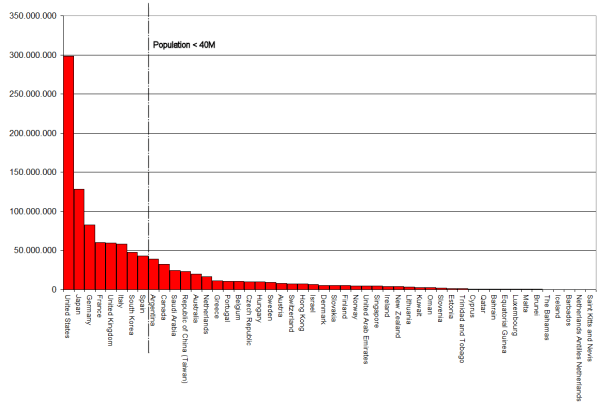
You don’t have to be as small as Iceland to be ignored online. Denmark (population 5.4 million), Sweden (9 million), The Netherlands (16 million) are often in the same situation – some “international” companies hardly touch France (60 million) or Germany (82 million) because it’s not worth their while. As an example, the search wars between MSN, Yahoo! and Google mainly evolve around the English speaking market and China these days.

Now here’s some news for you guys: 1/4 of your best potential customers live in countries with less than 40 million inhabitants!

The chart below plots the population of the 50 countries in the world with highest GDP per capita, ordered by population:

(click for larger image)

It turns out that countries have a long tail too. “Nah – let’s just rule out these 300 million of the world’s best consumers – they’re not worth the trouble” 😉

Actually – out of the 6.5 billion people in the entire world, about 23% live in the long tail: That’s 1.5 billion people.

Sure enough, there are translations to be made, legal issues to be sorted out and local partners to be signed. But if Google makes say 5 billion (guesstimate) out of their expected 10 billion dollar revenues this year from the US, how can they ignore corresponding 150 million dollar revenues in Sweden? Or even the 5 million dollar revenues in Iceland?

The numbers for iTunes are about 10x smaller – it’s still a lot of money in the long tail markets. Come on guys – you can do it, you might even find someone to make the initial investment for you – and they’d probably already have better connections than you’d make in a year.

If resources are the problem – team up. People stumble over each other for smaller opportunities than these.

Madonna

Rakst á þetta í gömlu dóti sem ég hef sett saman í gegnum tíðina:

Strange face images

The brain is extremely good at recognizing human faces and is believed to have a special module or part that is responsible for analyzing faces
(Carter, Rita; Frith, Christopher. (1999). Mapping the mind. University of California Press).

This module is obviously very handy, but it can also play nasty tricks with our perception.


Look at the image here to the right. You will most certainly recognize the famous singer and actress Madonna. The photo is upside down, but otherwise it seems normal to you, right?

Well, prepare yourself for a mind-boggler.


The image to the LEFT is is the same image as before, only rotated 180° to be "right". Not a pretty sight, is it? If you don’t believe me, print the image or copy it to a graphics editor and rotate it 180° again.

The image on the RIGHT is the original image for comparison. What a relief! (Original image courtesy of: WireImage.com)

What? How? In the funky image I have taken Madonna’s eyes and mouth and rotated them 180°. In addition I switched the right and left eyes (we are also extremely good at recognizing only eyes).

We are not used to faces being this way and therefore the face recognition module assumes all is in order and even recognizes the face. When we turn it around, the face recognition module instantly sees that something is terribly wrong.

Fleiri myndir frá Afríku / More photos from Africa

Magga er búin að setja upp annað myndasafn. Í fyrra safininu var það sem við völdum sem bestu myndirnar úr ferðinni, en í nýja safninu eru myndir sem segja ferðasöguna. Þessvegna eru líka smá textabútar hér og þar sem útskýra það sem um er að vera.

Nýja myndasafnið er hér.

P.S. Tabblo er snilld.

– – –

More photos from Africa, the previuos one was all the best photos (from a photographical standpoint), this time it’s the story – with comments inbetween.

New album here.

P.S. Tabblo rocks.

Displaying your Spurl.net bookmarks on your own page

I was playing with this new blog’s template. I had actually forgotten how incredibly easy it is to include your own bookmarks in your own page, complete with folders and everything. The following assumes that you are a Spurl.net user and make note that it will only show the links that you’ve chosen to publicly display (publish).

When that’s set, here are the steps to integrate with your page:

  1. Download this file, extract the php file inside it – called spifdata.php – and put it into a directory called “spif” under the path where you want to use the tree-view. For this page – hjalli.com – the path needs to be: http://www.hjalli.com/spif/spifdata.php (not that it will do anything on its own though).

    Make sure that the “spif” directory is writable by the user “apache” (or whatever the web server user on your server is). This is likely to be a default setting on the server though.

  2. Include this code in your page where you want the tree to appear (you can this very page as an example)

    <div class="spTree">
    <div id="spfc-0" class="spTreeFolderContent">Loading...</div>
    </div>
    <iframe id="spLoader" style="display:none;" width="0" height="0">
    </iframe>
    <script src="http://www.spurl.net/spif/user/user2.js"></script>
    <script>initPage('hjalli');</script>

    …replacing ‘hjalli’ with your username.

  3. Include this line in the section of your page:

    <link href="http://www.spurl.net/variants/default/css/sptree.css"
    type=text/css rel=StyleSheet>

That’s it!